Ask most robe buyers what their robes are made of and the answer stops at cotton. But cotton is a category, not a spec, and the differences inside it decide whether a robe feels plush, dries between guests, sheds lint into the wash, or survives two years of industrial laundering. The weave you already know about, terry against waffle against velour. Underneath the weave sits the fiber, and the fiber is where the real quality is set. This is a look at the cotton itself, and how to choose it on purpose.
The one number that explains most of it is staple length, the length of the individual cotton fibers before they are spun into yarn. Longer fibers make smoother, stronger yarn with fewer loose ends, which means less shedding, less pilling, more strength, and more even dye uptake. The industry sorts cotton into bands: short-staple runs under about 1.0 inch, mid-staple from roughly 1.0 to 1.125 inches, long-staple from about 1.125 to 1.375 inches, and extra-long staple, the premium tier, at 1.375 inches and above. Everything marketed as luxury cotton is really a claim about sitting in those top two bands.
The named cottons and where they actually fall
The famous names map onto that scale in ways worth knowing. Egyptian cotton is a family, not a single grade: the well-known Giza varieties range from around 1.3 inches for Giza 86 up to 1.5 inches and beyond for Giza 88, putting the best of them firmly in extra-long-staple territory. American Pima, sold under the Supima trademark when it is verified US-grown, sits around 1.4 inches and up, also extra-long staple. Turkish cotton, the name most associated with robes and towels, is typically shorter than both, in the neighborhood of 1.1 to 1.2 inches, which lands it at the long end of mid-staple to the start of long-staple. Ordinary upland cotton, the commodity grade, sits below one inch.
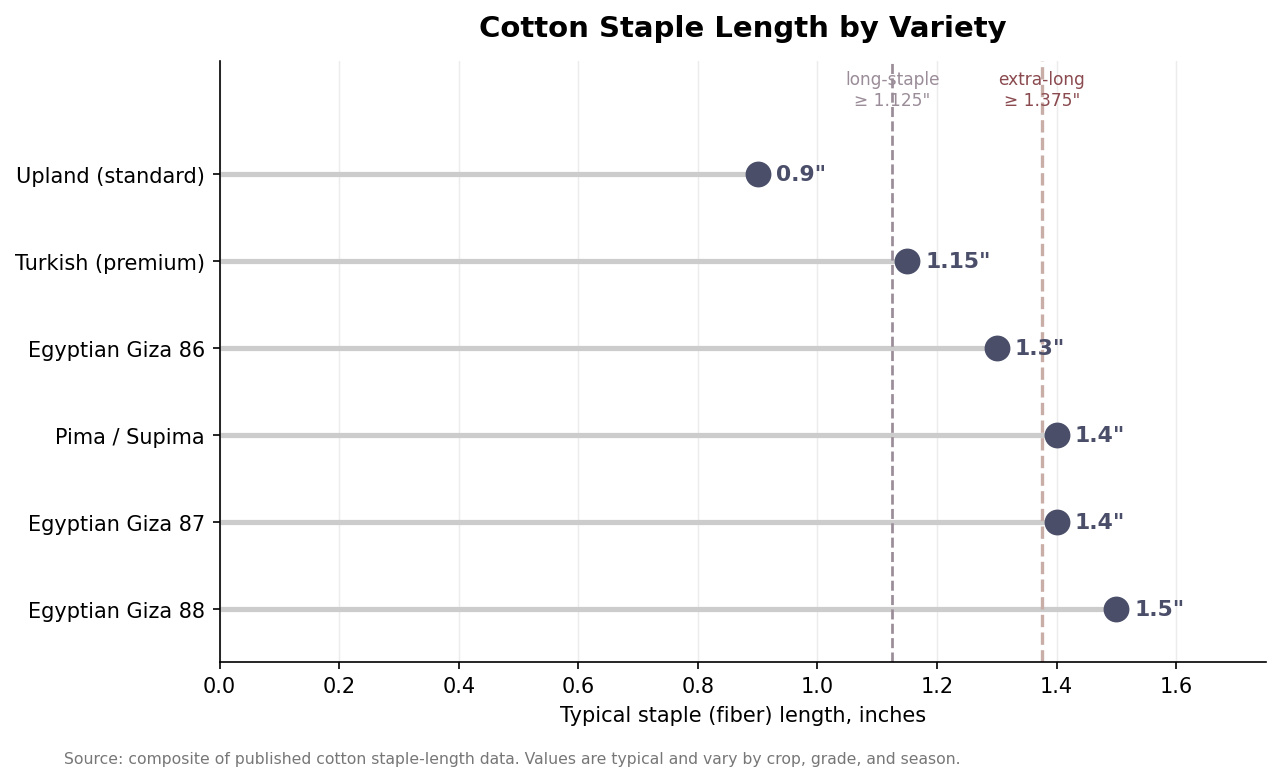
That chart carries a warning as much as a ranking. It is tempting to read it top down and conclude that Giza 88 Egyptian is simply the best robe cotton because its fiber is longest. For a bedsheet that logic mostly holds. For a robe it does not, and understanding why is the whole point.
Why the longest fiber is not automatically the right robe
A robe has a job a sheet does not: it has to absorb water off a wet body and then give that water back to the air so the robe is ready for the next use. Egyptian cotton makes an ultra-soft, plush, dense robe, but that density holds moisture, and a heavy Egyptian robe can stay damp longer than a busy spa or pool wants. Turkish cotton, despite its shorter staple, is the go-to for spa, pool, and hotel robes precisely because it is absorbent and quick-drying, woven with larger terry loops that grab water and release it, and it famously grows softer and fluffier with each wash rather than matting down. Pima lands in the middle: absorbent, durable, and fluffy, a dependable mid-range fiber that is a touch less indulgent than top Turkish or Egyptian. Standard cotton is less absorbent than any of these specialized varieties, though its hypoallergenic simplicity has a place for sensitive skin.
So the honest hierarchy is not a single ladder. It is a match between fiber behavior and use. Longer staple wins on softness, strength, and lint; loop construction and drying speed win on turnaround and freshness. A great robe cotton balances both for its setting.
Matching the cotton to the robe’s job
Line the varieties up against where the robe will live and the choice gets easy. For a spa, pool, or gym where robes cycle fast and must feel fresh, Turkish cotton is the natural pick for its quick-dry loops. For a luxury hotel suite or a premium retail gift where plush hand and a heavy, enveloping feel sell the experience, Egyptian or a high-grade Turkish rewards the spend. For a mid-tier hotel, corporate gift, or home program that needs durability and comfort without the top price, Pima is the value sweet spot. For sensitive-skin or budget-driven programs, a clean standard cotton does the job.
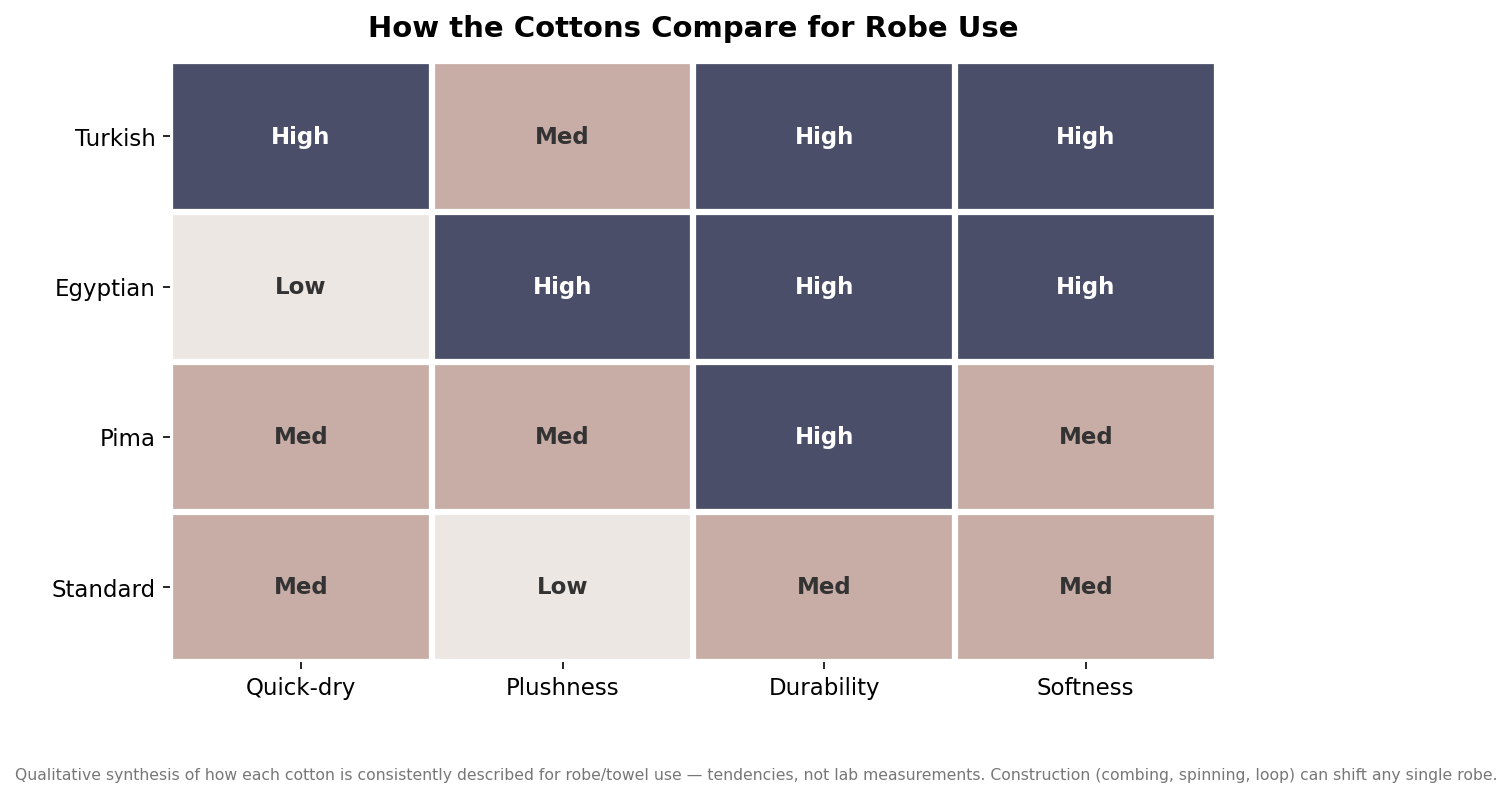
The matrix above is a qualitative synthesis of how these fibers are consistently described for robe and towel use, not a lab measurement, and it is meant to be read as tendencies rather than guarantees. A superbly constructed standard-cotton robe can outperform a cheaply made Egyptian one, because construction is the other half of the story.
What to ask for, and what to verify
Fiber name alone is not a spec, so pin down the details that separate a robe that lasts from one that disappoints. Ask whether the yarn is combed rather than carded, since combing removes the short fibers that cause pilling and fuzz; ask whether it is ring-spun, which produces a smoother, stronger yarn than open-end spinning; and ask about the terry loop construction, because loop density and height drive absorbency at least as much as the fiber does. Low-twist or zero-twist loops feel plusher and absorb faster but can be less durable under harsh commercial laundering, a real trade-off for a hotel versus a home robe.
Two cautions save the most grief. First, be skeptical of the bare phrase Egyptian cotton or luxury cotton with no staple length, grade, or origin behind it, because those words are widely used and lightly policed; a genuine supplier can tell you the variety and roughly where its staple falls. Second, watch for cotton-polyester blends sold as cotton: a poly blend can boost durability and cut drying time and cost, which may be exactly right for a high-abuse gym program, but it is a different product from pure cotton and should be a deliberate choice, not a surprise. Get the fiber, the spinning, and the loop specified in writing, and the robe you picture is the robe that arrives.